
Research Contents
Our unique researches based on MSEP
Research ContentsCO2 utilization
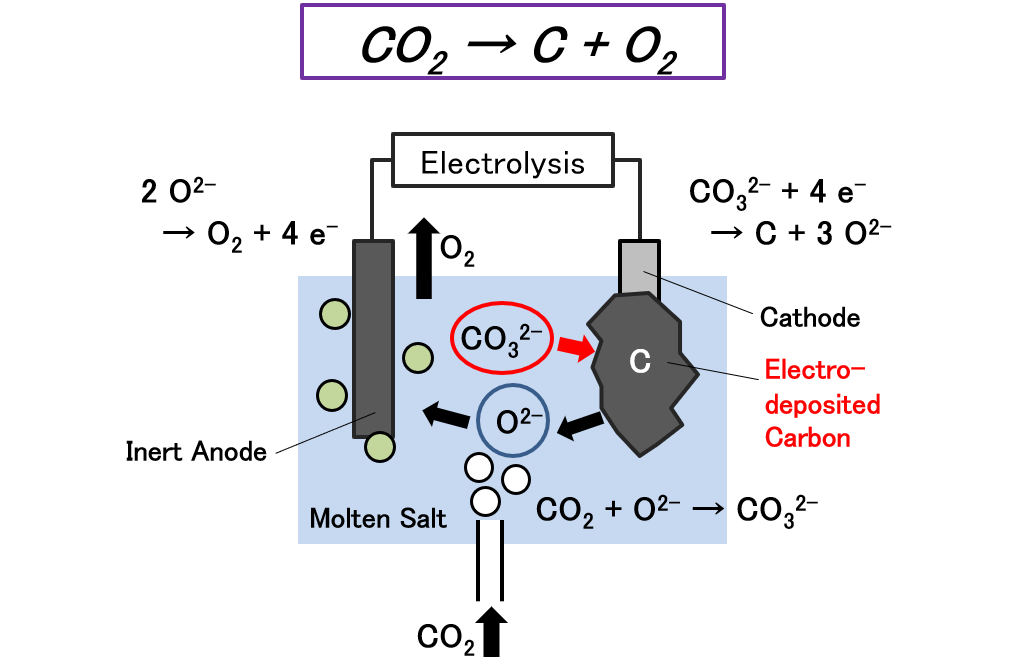
Under the global goal of achieving carbon neutrality by 2050, society is increasingly seeking not only to reduce CO2 emissions and capture them for storage—a passive approach—but also to actively utilize CO2 as a valuable resource.
At I’MSEP, we aim to realize a “carbon driven society” by developing and implementing innovative technologies that make such utilization possible. The fundamental reaction underlying this technology is as follows.
When potassium carbonate is dissolved in molten chloride and electrolyzed, a carbon film forms on the cathode surface:
Cathode reaction: CO32- + 4e- → C + 3O2-
When CO2 gas is introduced into the molten salt, part of the O2- ions react:
CO2(g) + O2- → CO32-
The resulting CO32- ions are again reduced to carbon at the cathode. Excess O2- ions are converted into oxygen gas at the anode:
Anode reaction: 2O2- → O2↑ + 4e-
Overall reaction: CO2 → C + O2↑
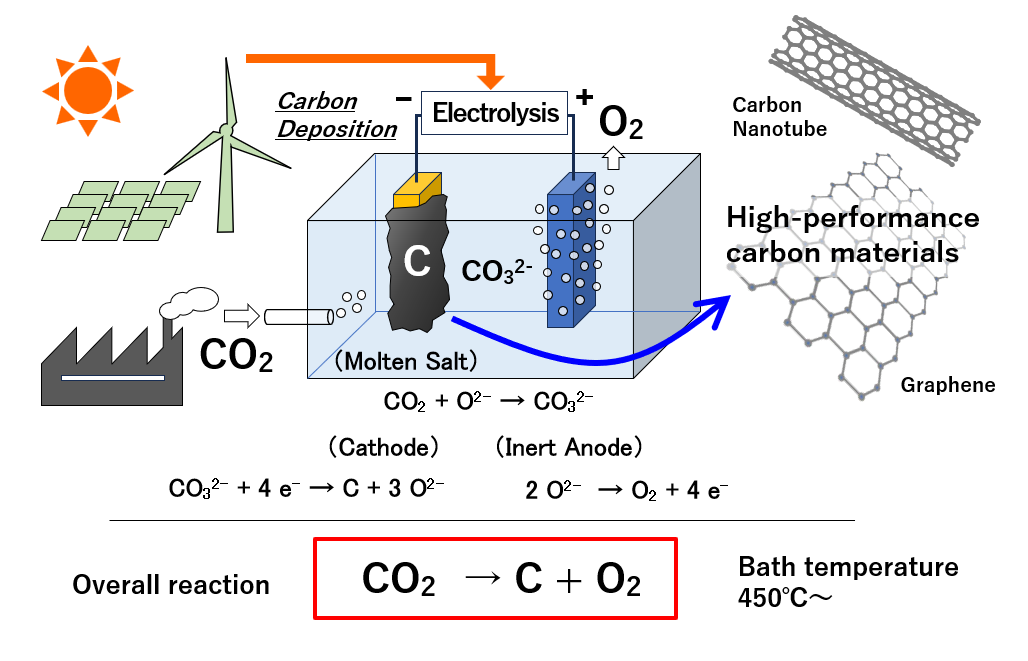
The carbon produced at the cathode can be obtained in various morphologies and structures by adjusting the electrolysis conditions. Experiments have confirmed the formation of smooth, highly adherent carbon plating films.
If this system is realized, CO2 emitted from thermal power plants or industrial facilities can be absorbed into molten salt and converted into carbonate ions. Using renewable energy to electrolyze the molten salt, the CO2 can then be transformed into high performance carbon materials or fixed as solid carbon fuel.
The resulting carbon can be used as:
・Materials for electrochemical energy conversion devices
・Fuel for direct carbon fuel cells or integrated CO2 electrolysis–fuel cell systems
・A reducing agent in metal refining
I’MSEP positions this technology as a key enabler of a future CO2 resource utilization and recycling system and is actively advancing its development.
As a concrete example, we have launched a joint project with SEC Carbon Co., Ltd. to apply the functional carbon produced by this method to improve the performance of in vehicle secondary batteries for electric vehicles (EVs). We are steadily progressing along the roadmap toward commercialization and social implementation.
Research ContentsCarbon plating
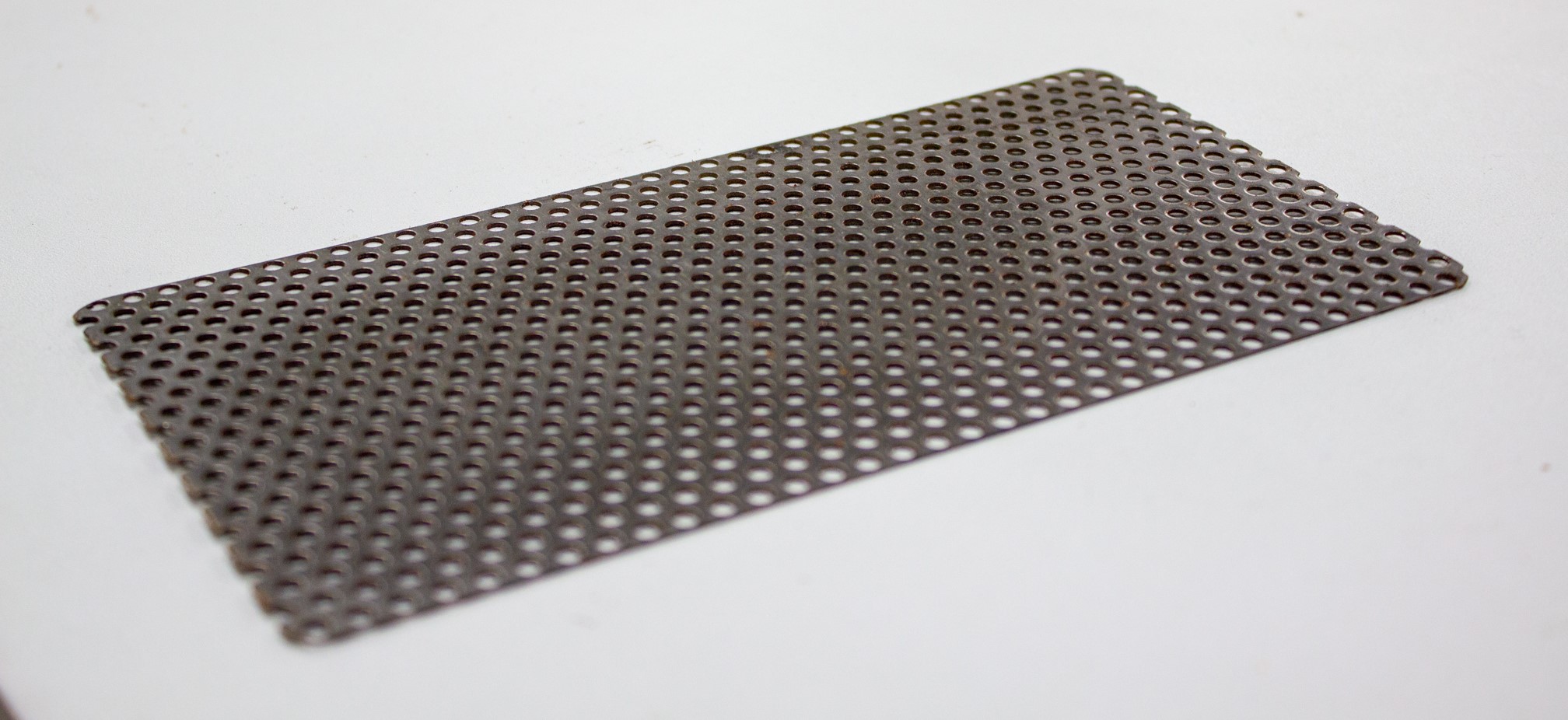
I’MSEP Co., Ltd. has achieved “electrolytic carbon plating” using molten salts as the electrolytic bath—something that has been extremely difficult to realize in aqueous systems. This innovative technology is based on electrochemical reactions, similar to the widely used aqueous based electroplating processes.
In this method, carbide ions (C22-) present in the molten salt serve as the carbon source. When a metal substrate is used as the anode, the C22- ions are oxidized, forming a carbon plating layer on the surface of the metal. This breakthrough technology can significantly enhance the performance of electrochemical energy conversion devices to meet the demands of the emerging EV and 5G era. It can also improve the corrosion resistance of fasteners such as bolts, nuts, and screws. Furthermore, applications are anticipated in heat transfer and heat dissipation components, electrodes for various electrolysis processes, and biosensors.
This technology is positioned as an important contribution to society as it embraces the SDGs and moves toward a carbon neutral, cleaner future.
Research ContentsMetal recycling
Rare earth elements can be selectively extracted, separated, and recovered from discarded permanent magnets. Notably, even those elements that are difficult to isolate using conventional hydrometallurgical or pyrometallurgical techniques can be selectively recovered when processed in molten salts.
This approach enables the efficient utilization of a broad range of rare metals, including high‑melting‑point and high‑hardness metals, precious metals, and rare earth elements.
Research ContentsElectrolytic refining
Molten salt electrolysis remains an essential technology for metal production and continues to be widely utilized in the industrial smelting of aluminum, magnesium, and rare earth metals. To support the sustainable advancement of this technology, we engage in activities such as materials development through small scale electrolysis experiments and the proposal of improved electrolytic cell designs.